

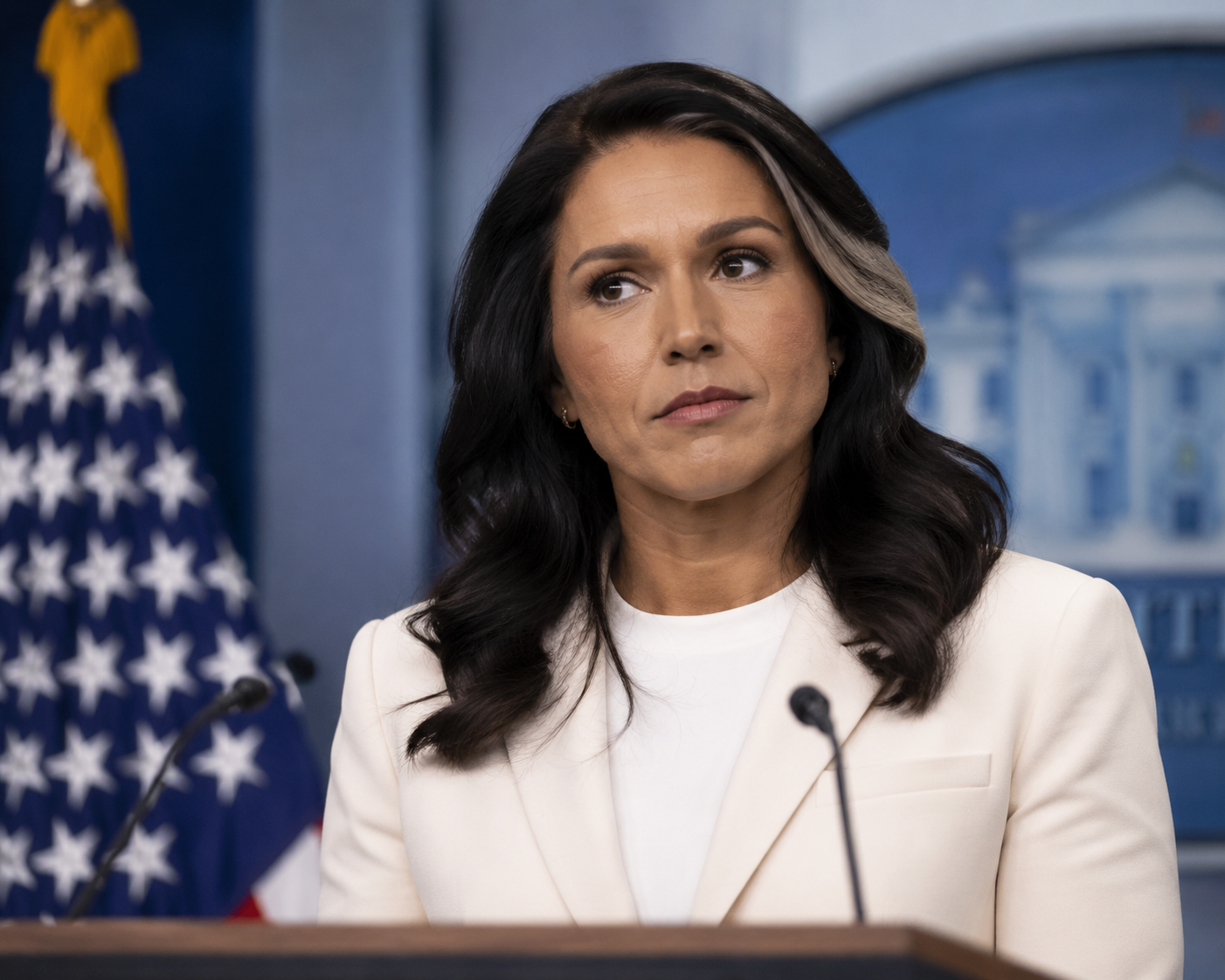
Washington was caught off guard Friday when Tulsi Gabbard, one of the most prominent and controversial figures in President Donald Trump’s administration, announced her resignation as Director of National Intelligence — stepping down not amid political pressure, but for a deeply personal reason: her husband has been diagnosed with a rare and serious form of bone cancer.
Gabbard addressed her resignation letter directly to Trump, saying she had to step down in order to support her husband Abraham Williams, who has recently been diagnosed with an extremely rare form of bone cancer. For a woman who has spent her career in the most demanding corners of public service — from military deployments to Capitol Hill to leading 18 intelligence agencies — it was a rare moment of vulnerability laid bare for the world to see.
“At this time, I must step away from public service to be by his side and fully support him through this battle,” she wrote in the letter, which she posted publicly on X. Her last day is set for June 30.
Trump’s response was warm but brief. He confirmed on Truth Social that Gabbard was “unfortunately” departing, writing that she has “done an incredible job, and we will miss her,” and adding that Principal Deputy Director of National Intelligence Aaron Lukas will take over from Gabbard in an acting capacity.
But behind the kind words lies a more complicated story. Gabbard is now the fourth member of Trump’s Cabinet to exit during this administration, following the firings of Kristi Noem as Homeland Security Secretary in early March, former Attorney General Pam Bondi in early April, and the departure of former Labor Secretary Lori Chavez-DeRemer in late April. The revolving door at the top of the Trump White House shows no signs of slowing.
As DNI, Gabbard was tasked with overseeing 18 intelligence agencies and advising Trump on intelligence matters. But she quickly came to be seen as ineffectual and appeared out of place in the administration — conspicuously absent from both the public messaging on the Iran war and from behind-the-scenes deliberations.
Her exit also follows that of her former top aide, ex-National Counterterrorism Center Director Joe Kent, who left the administration roughly two months ago with a fiery resignation letter arguing that Trump had launched the Iran war under pressure from Israel despite Tehran posing “no imminent threat” to the United States. That departure had already left Gabbard politically isolated within an administration that was increasingly moving in a direction she had spent her career opposing.
Gabbard’s story was always an unusual one — a former Democratic congresswoman from Hawaii who fell out with her party, later joined the Republicans, and was confirmed as the nation’s top intelligence chief less than a month after Trump’s second term began. She came in as an outsider and, in many ways, leaves as one too.
Whether her departure signals deeper instability at the heart of the Trump intelligence apparatus — or simply a family emergency pulling a public servant home — Washington will be watching closely in the weeks ahead.
Sources: NBC News, Reuters, Washington Post

