

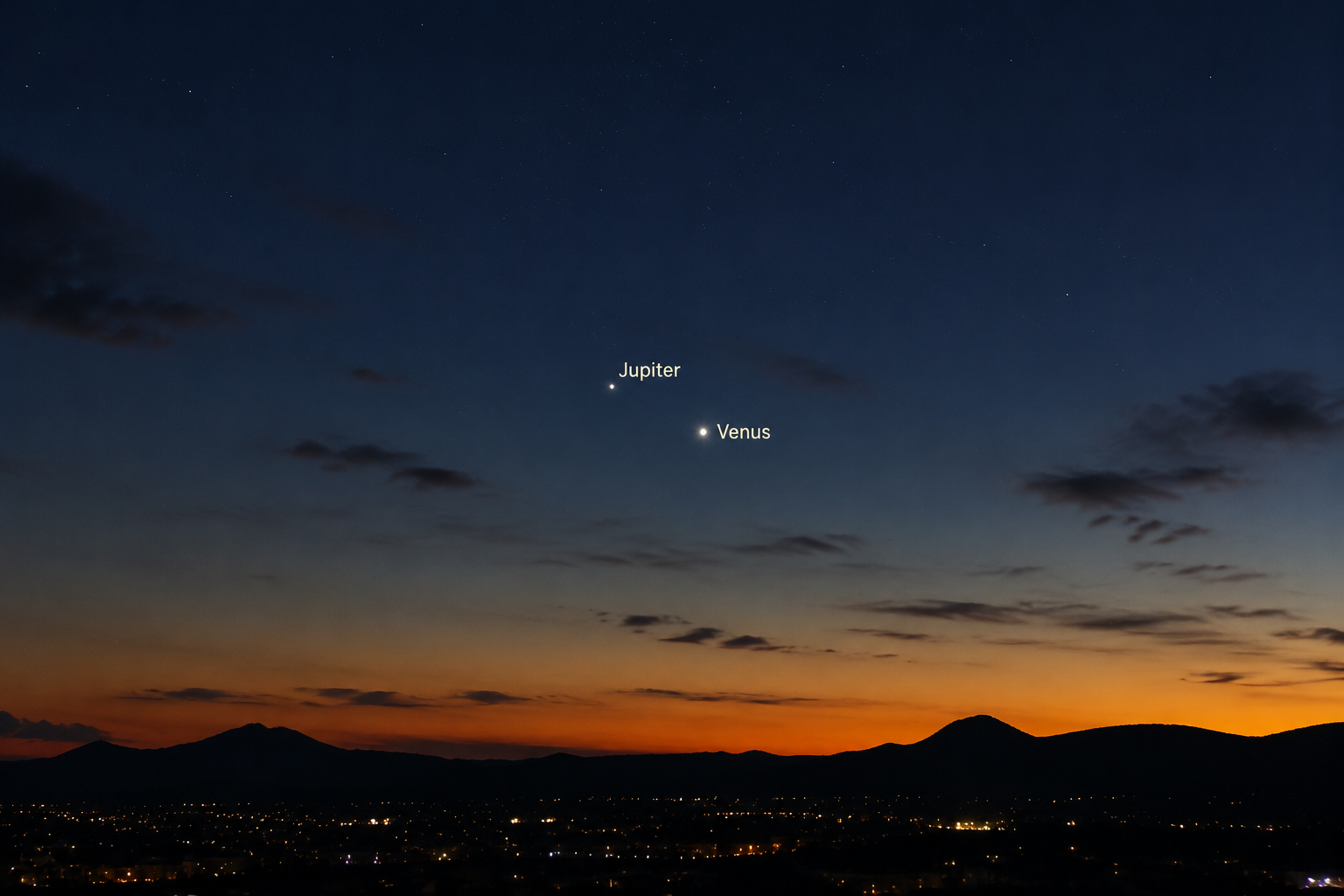
If you have not looked up at the western sky after sunset recently, June is your reminder to start. Two of the brightest objects in the night sky — Venus and Jupiter — are closing in on each other night by night, and on June 9 they will appear so close together that the sight will be visible to the naked eye from almost anywhere on Earth.
On June 8 and 9, 2026, Venus and Jupiter — the two brightest planets visible from Earth — will have a spectacular conjunction, appearing approximately three moon-widths apart, or roughly 1.5 degrees from each other in the sky. Astronomers call this a conjunction, but the word barely captures what it actually looks like: two brilliant points of light seemingly leaning in toward each other in the twilight, close enough that many first-time observers mistake them for a single object.
The show does not require any special equipment. Venus and Jupiter will be bright enough to see with the naked eye, and with conjunctions like this it is often better not to restrict your view by looking through a telescope eyepiece. A clear western horizon and a willingness to step outside shortly after sunset is all that is required.
Step outside about an hour after sunset and look toward the west-northwest. Two bright starlike bodies will be approximately 15 degrees above the horizon — brilliant Venus sitting 1.6 degrees to the upper right of Jupiter, the two brightest starlike bodies in the entire sky. Even in light-polluted cities where most stars disappear, this pairing will cut through the haze without difficulty.
The window is not a long one. There will be roughly one hour between sunset and the two planets setting beneath the horizon, which is exactly why finding a clear western horizon matters. Trees, buildings, or hills blocking the lower western sky will shorten that window considerably. Getting to an open space — a park, a rooftop, or an elevated spot facing west — makes a significant difference.
The buildup to June 9 is already underway and worth watching each evening. Tonight, May 31, Venus, Jupiter, and Mercury are already lining up in the western sky after sunset, with Venus rapidly closing the gap to Jupiter ahead of their June 9 conjunction. Each clear evening between now and then, the gap between the two planets will visibly narrow — one of those rare cases where a celestial event unfolds slowly enough to follow night by night with no equipment at all.
After the main event, the sky does not immediately go quiet. On June 16, a thin crescent moon will make a triangle with Jupiter and Mercury, and on June 17, the moon will appear just slightly higher than Venus — a second act that gives anyone who missed the June 9 conjunction another reason to look up.
The broader context, however, is bittersweet for Jupiter fans. Jupiter is approximately two weeks away from solar conjunction on June 24, 2026 — the date when it passes behind the Sun from Earth’s perspective. As it approaches that point, it sinks lower in the western evening sky each night, sitting in brighter twilight and gradually fading from view. June 9 may be your last clean look at Jupiter for several weeks before it disappears entirely into the Sun’s glare and reemerges before dawn in mid-August.
In reality, the orbits of Venus and Jupiter around the Sun are incredibly far from each other — this apparent closeness is simply a matter of perspective, caused by the way we observe a three-dimensional cosmos projected onto a two-dimensional sky. But perspective, on a clear June evening with two planets glowing side by side above the western horizon, is everything.
Sources: BBC Sky at Night Magazine, Forbes, CBC

