

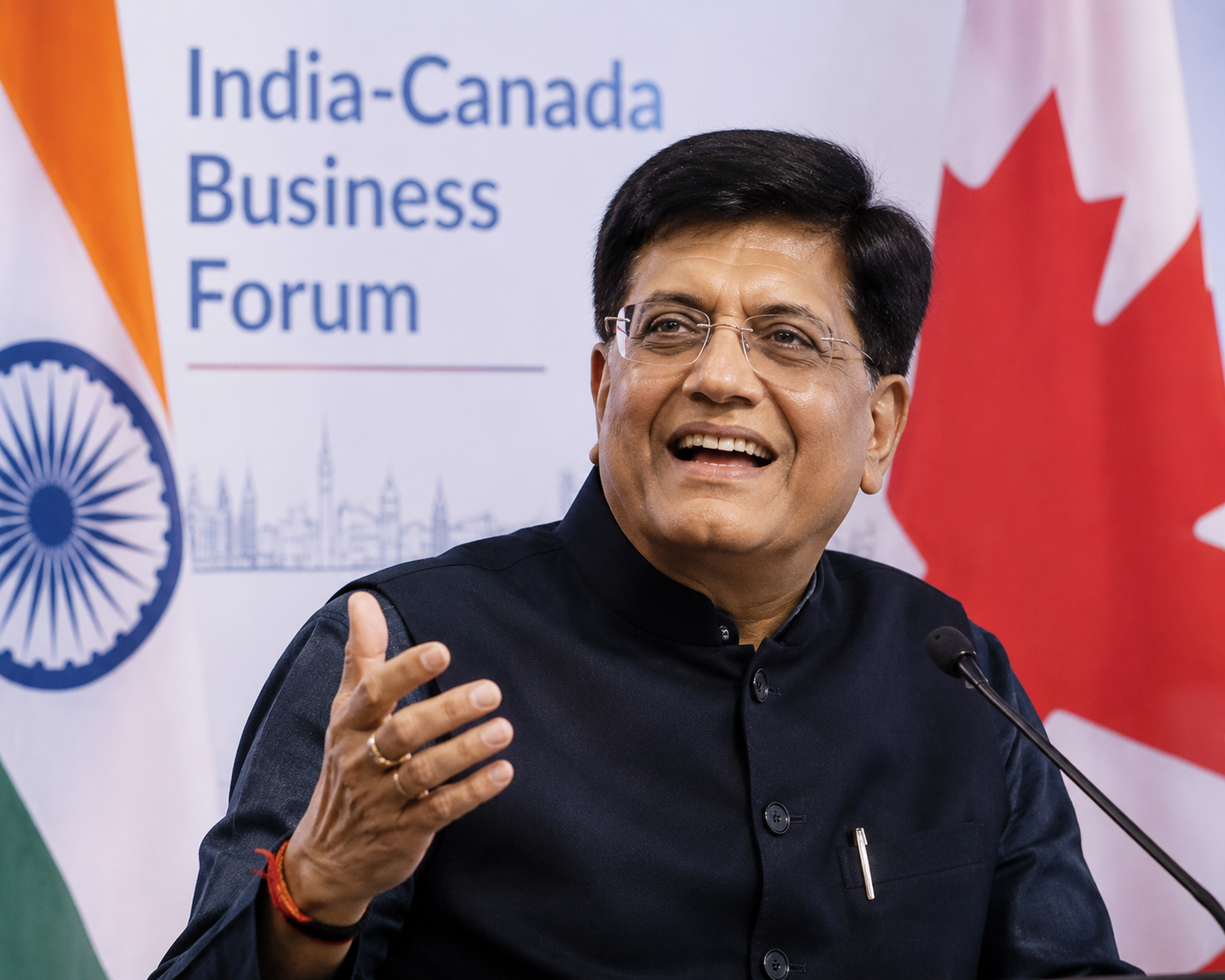
India is sending one of its most powerful trade ministers to Canada next week, backed by a delegation of 150 business leaders — a move that signals just how seriously New Delhi is treating its renewed push to lock down a comprehensive trade deal with Ottawa.
Commerce and Industry Minister Piyush Goyal will begin his three-day visit to Canada from Monday, accompanied by a business delegation and a team of negotiators, to accelerate trade talks for the proposed Comprehensive Economic Partnership Agreement, which both sides are aiming to conclude by December.
The visit carries considerable diplomatic weight given the turbulent recent history between the two nations. India and Canada had watched their relationship deteriorate sharply in 2023, after then-Canadian Prime Minister Justin Trudeau alleged Indian government involvement in the killing of a Canadian Sikh separatist — an allegation New Delhi flatly denied. Trade talks that had resumed after a decade were paused in September 2023 following those allegations, and the relationship endured a prolonged chill before a new Canadian government under Prime Minister Mark Carney began working to reset ties.
Now the thaw is moving quickly. Earlier this year, India and Canada revived discussions on a free trade agreement and in March signed the Terms of Reference for the India-Canada Comprehensive Economic Partnership Agreement. At the time of signing, Prime Minister Narendra Modi set an ambitious bilateral trade target of $50 billion by 2030. Two full rounds of CEPA negotiations have already taken place, with the second round concluding in New Delhi as recently as May 4-8.
Discussions during Goyal’s visit are expected to cover cooperation in clean energy, nuclear energy, agriculture, and critical minerals — sectors where both countries see significant untapped potential. Canada is one of the world’s largest producers of critical minerals, while India is one of the fastest-growing consumers of energy and raw materials, making the pairing strategically logical for both sides.
The numbers illustrate how much ground remains to cover. In the last financial year, India’s goods exports to Canada stood at $4.2 billion, while imports from Canada came to $3.08 billion — a combined figure that both governments agree falls well short of the two economies’ actual potential. Canada is also home to 425,000 Indian students, making it a key market for India’s services exports in telecommunications, computing, and professional services — a sector expected to grow substantially once CEPA is finalised.
India’s Federation of Export Organisations called the visit a significant step towards strengthening bilateral economic and trade relations, expressing confidence that Goyal’s presence in Ottawa will provide fresh impetus to the CEPA negotiations and pave the way for deeper economic integration between the two countries.
For both governments, the timing is deliberate. With U.S. tariff policies reshuffling global supply chains and pushing countries to diversify their trade partners, India and Canada are betting that their complementary economies — one a resource-rich G7 nation, the other the world’s most populous country and fastest-growing major economy — make for a partnership worth finally getting right.
Sources: Reuters, Bloomberg, BusinessToday

