

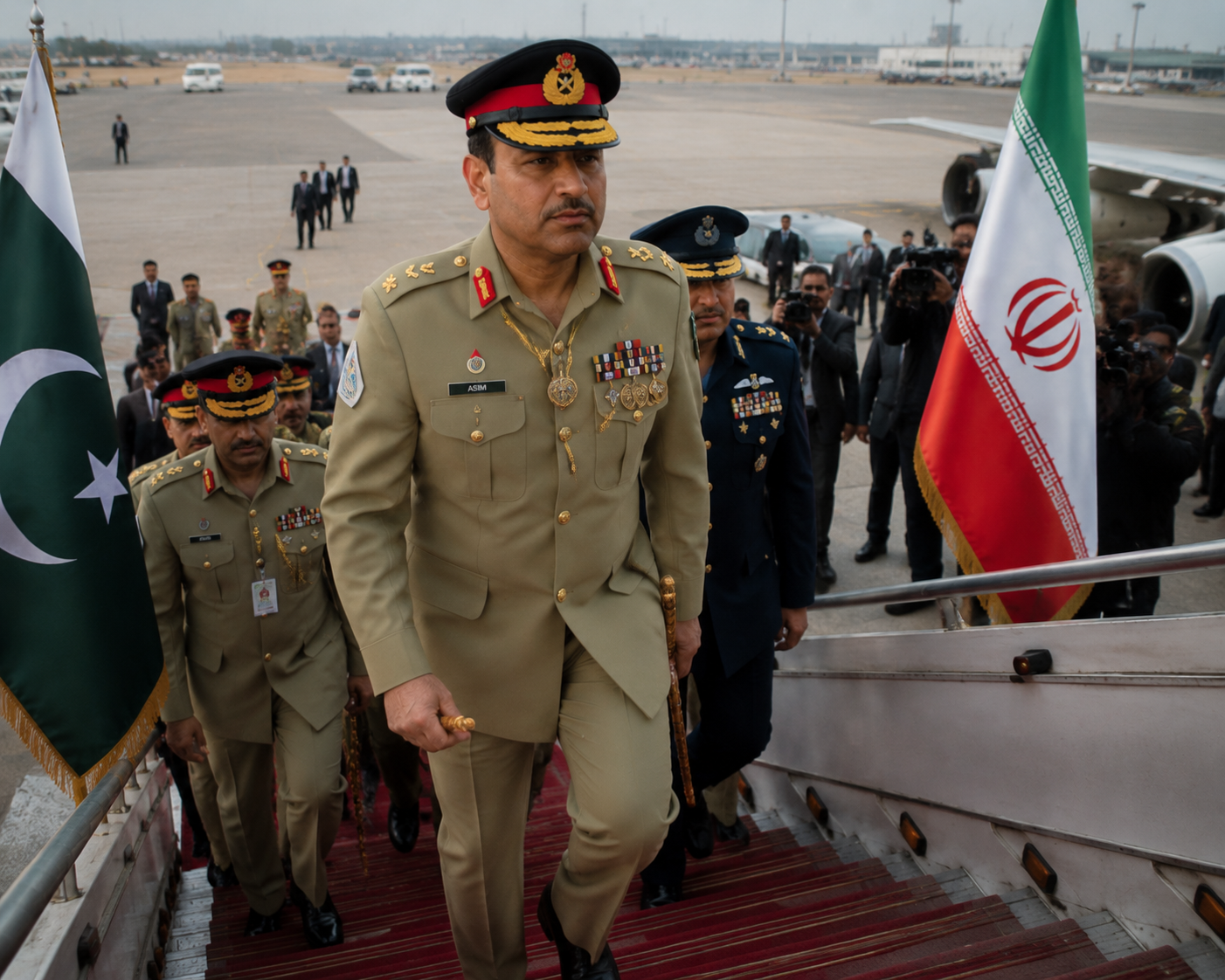
The Middle East’s most consequential diplomatic drama took another sharp turn on Saturday when Pakistan’s powerful army chief, Field Marshal Asim Munir, landed in Tehran for high-stakes mediation talks — arriving at a moment when the difference between a peace deal and a renewed war may come down to just a few tense days of negotiation.
Pakistan’s military said Field Marshal Asim Munir had arrived in Tehran as part of ongoing mediation efforts. He was welcomed by Iran’s Interior Minister Eskandar Momeni and Pakistan’s Interior Minister Mohsin Naqvi, who had himself visited Tehran twice in the past week alone — meeting with Iranian President Masoud Pezeshkian and Foreign Minister Abbas Araghchi on both occasions. The sheer frequency of these visits signals that all parties involved understand time is running out.
Munir met Iranian Foreign Minister Abbas Araghchi late into the night, with the pair exchanging views on the latest diplomatic efforts and initiatives to prevent escalation of tensions, according to a post on Araghchi’s official Telegram channel. What was said behind closed doors, however, remains unknown — and that uncertainty is exactly what has markets, governments, and military planners on edge.
The backdrop to Munir’s visit is one of mounting pressure from Washington. U.S. Secretary of State Marco Rubio said on Friday that “slight progress” had been made during talks with Iran, speaking just days after President Trump said he was holding off on a military strike against the Islamic Republic because “serious negotiations” were underway. Trump has been threatening for weeks that the ceasefire reached in mid-April could end if Iran does not make a deal.
But Rubio was careful not to oversell the moment. He said he did not want to exaggerate the progress, acknowledging there had been “a little bit of movement, and that’s good,” while adding that conversations were ongoing. In recent weeks there have been repeated claims of progress, but a deal has consistently stayed out of reach.
Iran, for its part, is pushing back hard on the terms being discussed. Iran’s mission to the United Nations accused Washington of “excessive demands” that are pushing peace talks towards collapse, amid reports that the Trump administration is simultaneously preparing for strikes on Iran should negotiations fail. Iran’s foreign ministry spokesman added that the disagreements between Tehran and Washington remained “deep and extensive” — a stark contrast to the cautiously optimistic language coming out of the American side.
Rubio made Washington’s bottom line clear: “The fundamentals remain the same. Iran can never have a nuclear weapon.” Tehran, meanwhile, has insisted the nuclear issue cannot even be part of the current discussions — a fundamental gap that no amount of shuttle diplomacy has yet been able to bridge.
Pakistan hosted the only direct U.S.-Iran talks since the war began — historic face-to-face negotiations held in Islamabad — and Munir played a central role in that round, greeting both delegations personally. That gives Islamabad a credibility in this process that no other country currently holds, and it is precisely why Munir’s late-night meetings in Tehran carry weight that diplomatic statements alone cannot convey.
For now, the ceasefire holds. But with Trump threatening renewed strikes, Iran accusing Washington of bad faith, and Pakistan’s top general shuttling between capitals in the dead of night, the fragile quiet in the Middle East feels less like peace and more like the silence before a storm.
Sources: Al Jazeera, France 24

