

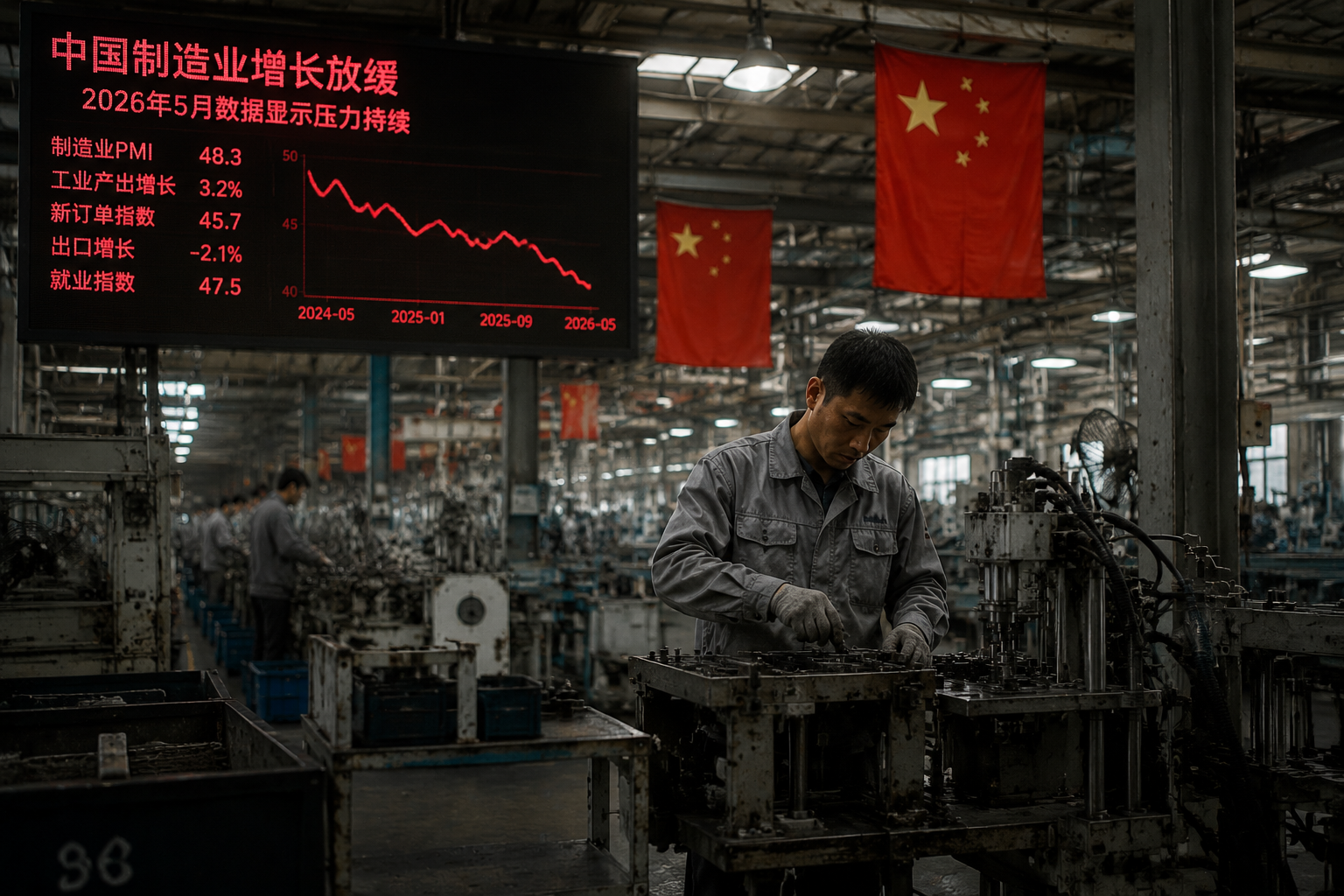
China’s vast manufacturing sector has hit a wall. Fresh data released Sunday morning showed factory activity in the world’s second-largest economy grinding to a near-standstill in May, raising fresh doubts about Beijing’s ability to sustain the growth momentum it had carefully been trying to rebuild since the start of the year.
China’s official manufacturing purchasing managers’ index dropped to 50.0 in May from 50.3 in April — the lowest reading in three months — sitting precisely on the threshold that separates expansion from contraction, according to a survey published by the National Bureau of Statistics. The number matched what economists had forecast, but matching a weak expectation is hardly reassuring when the underlying details tell an even more uncomfortable story.
Supply improved while demand weakened. The production sub-index came in at 51.2, suggesting factories were still making things — but the new orders sub-index slipped to 49.9, falling below the critical 50-point mark and confirming that those factories were struggling to find buyers. The gap between what China is producing and what the world wants to purchase from it has rarely been more visible.
The export picture was worse still. New export orders fell sharply to 48.6 from 50.3 in April, heaping pressure on policymakers to reduce the economy’s reliance on overseas demand and find ways to strengthen domestic consumption instead. That pressure is not new — Beijing has been trying to rebalance its economy toward domestic spending for years — but the speed of the May deterioration gives that challenge a new urgency.
Part of the problem is coming from thousands of miles away. The U.S.-Israeli war with Iran, which started in late February and led to the effective closure of the strategic Strait of Hormuz, has sent energy prices surging — threatening to squeeze manufacturers’ profits as costs soar. Chinese factories cannot control what happens in the Persian Gulf, but they are absorbing the consequences through higher raw material bills that are eating into their already thin margins. The gauge for raw material prices in the manufacturing PMI came in at 60.5 — down from 63.7 in April but still well above the 50-point mark, confirming that input costs continued to rise.
Not everything in the data was bleak. High-tech and equipment manufacturing outperformed the overall sector in May, logging PMI readings of 52.9 and 52.1 respectively — a sign that China’s push to dominate next-generation industries is gaining traction even as traditional manufacturing stumbles. The services sector also showed signs of life. The non-manufacturing PMI, which covers services and construction, rose to 50.1 from 49.4 in April, helped by a surge in travel spending during the five-day May Day holiday.
The geopolitical backdrop is adding another layer of complexity. A summit between Chinese and U.S. leaders in Beijing in mid-May did not result in an extension of the trade truce the two governments reached late last year, although both sides agreed to explore areas for tariff cuts on goods worth some $30 billion from each country. With no trade deal in sight and export orders already contracting, China’s manufacturers are being asked to compete in a global market that is becoming increasingly hostile to their products.
Weakness in the property market, employment, and consumer spending continues to dampen growth, leaving China reliant on global demand to absorb the goods produced by its manufacturing sector. Beijing has acknowledged the problem and set a less ambitious GDP growth target for 2026 — a quiet admission that the easy phase of post-pandemic recovery is over, and that the harder work of structural reform has only just begun.
Sources: Reuters, Business Standard, Business Today

